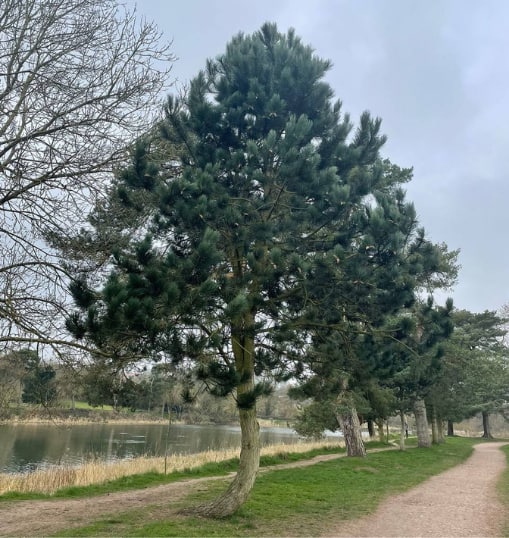
A large, established tree can be an important feature within a garden, but its size can sometimes become increasingly difficult to accommodate. Branches may extend further across the available space, the canopy can become dominant, and individual limbs may begin interfering with areas that previously had plenty of clearance. These changes do not automatically mean that the tree needs to be removed.
For homeowners in Whitstable, Kent, professional crown reduction can provide a practical way of managing certain large trees while retaining their established presence. The process involves selectively shortening suitable branches to reduce the height, spread or overall dimensions of the crown without simply cutting the tree back indiscriminately.
However, crown reduction should always be based on the needs of the individual tree. Its species, condition, structure, previous pruning and relationship with the surrounding garden all influence what can reasonably be achieved. The aim is not to make a large tree as small as possible, but to create a more manageable crown while retaining an appropriate structure for future growth.
How Does Crown Reduction Help Manage a Large Tree?
Crown reduction makes a tree more manageable by selectively reducing the dimensions of its canopy. Depending on the situation, the work may concentrate on overall spread, height, individual overextended limbs or a combination of these factors.
Branches are shortened to suitable growth points so that the remaining crown retains a balanced form. This is very different from indiscriminate cutting, where major limbs may simply be shortened without sufficient consideration of how the tree will respond.
When properly planned, crown reduction can help a large tree fit its available surroundings more comfortably while retaining much of its existing canopy.
What Does Tree Crown Reduction Actually Involve?
Crown reduction is a specialist pruning technique used to decrease the overall size of a tree’s canopy.
Rather than removing branches at arbitrary points, suitable sections are shortened back to appropriate lateral growth.
The exact amount removed depends on the tree and the reason for carrying out the work.
Some trees may require a relatively modest reduction across the complete canopy, while others may need greater attention on one side where branches have become disproportionately long.
Large Trees Do Not Automatically Need Removing
Tree size alone is not a reason for felling.
A mature tree can remain suitable for retention even when its crown has become larger than is convenient for the surrounding garden.
If excessive spread or height is the main problem, professional pruning may provide a more proportionate solution.
Assessing whether the tree can reasonably be managed allows alternatives to removal to be considered before more extensive work is recommended.
Identifying What Is Actually Too Large Is Important
When a tree feels overwhelming, it is useful to establish which part of the crown is creating the problem.
Sometimes height is the concern.
In other situations, the tree may have a suitable height but individual lateral branches have extended too far across the garden.
A tree can also become unbalanced when one side of the crown develops much further than another.
Understanding the actual problem allows crown reduction to be targeted rather than removing healthy growth unnecessarily.
Reducing Crown Spread Can Recover Useful Space
Lateral growth can gradually occupy a substantial amount of garden space.
Branches may extend over lawns, paths, patios or other frequently used areas.
Reducing suitable outer branches can bring the canopy back into better proportion with the available surroundings.
The objective is not necessarily to create a dramatically smaller tree. A carefully planned reduction may only need to remove enough growth to establish more practical separation between the crown and the areas around it.
Overextended Branches Can Be Managed Selectively
Sometimes the majority of a tree’s crown fits its surroundings perfectly well, but one or two limbs have become particularly long.
In these circumstances, a complete crown reduction may not be necessary.
Selective branch reduction can shorten the overextended growth while leaving suitable parts of the canopy largely unchanged.
This is an important part of proportionate tree surgery: the work should respond to the actual problem rather than applying the same treatment to the entire tree.
Managing Height Requires a Careful Approach
Where excessive height genuinely needs to be addressed, the reduction should be carefully planned.
Removing the upper crown indiscriminately can leave an unnatural shape and may influence how the tree subsequently develops.
Professional crown reduction selects suitable pruning points throughout the canopy.
This helps retain a functioning crown while achieving an appropriate decrease in overall dimensions.
More Pruning Does Not Necessarily Produce a Better Result
It can be tempting to request a very substantial reduction so that the tree remains smaller for longer.
Trees do not necessarily respond in this way.
Heavy pruning can encourage vigorous regrowth in some species, potentially creating numerous shoots around pruning areas.
A more proportionate reduction may provide a better basis for future management than removing excessive amounts of healthy growth in one operation.
Crown Reduction Should Preserve the Tree’s Natural Form
A professionally reduced tree should still look like a tree of its natural type.
Its overall proportions may be smaller, but the canopy should not simply appear abruptly cut back.
The natural shape varies between species, which means there is no single crown reduction specification suitable for every tree.
Working with the existing structure generally produces a more appropriate result than trying to force every canopy into the same shape.
Tree Species Influences the Appropriate Reduction
Different species grow and respond to pruning in different ways.
Some produce vigorous new shoots after cutting, while others have slower or more particular growth patterns.
The natural mature dimensions of the species also matter.
Professional tree surgery takes these characteristics into account when deciding how much crown reduction is appropriate and how the remaining canopy should be managed.
Tree Condition Should Be Assessed Before Pruning
A large crown is only one aspect of the tree.
Before reduction begins, its overall condition should also be considered.
The assessment may look at the trunk, major branches, branch unions, existing deadwood, damaged limbs and previous pruning.
A tree with a generally suitable structure may be a good candidate for proportionate crown management.
Where significant deterioration is present, the priorities may be different.
Mature Trees Often Benefit From a Measured Approach
Large mature trees may contain branches that have developed over many years.
Removing substantial established growth is therefore a significant intervention.
Where possible, a measured reduction can help address practical concerns without unnecessarily removing large parts of the crown.
The amount of pruning should be guided by what the tree can reasonably accommodate and what improvement is actually required.
Previous Pruning Changes How a Tree Develops
A tree that has already been reduced may have a different crown structure from one that has developed naturally.
New shoots can form around previous pruning points and may become increasingly substantial over time.
Before another crown reduction is undertaken, this existing regrowth should be assessed.
Simply returning to old cutting points without considering the present structure may not provide the most appropriate long-term result.
Repeated Heavy Cutting Can Create Dense Regrowth
Where a tree has historically been cut back severely, vigorous shoots may develop around previous pruning areas.
These shoots can eventually create a dense crown that appears to require another substantial reduction.
Repeating the same heavy treatment can create an ongoing management cycle.
A more selective approach may sometimes help establish a crown that is easier to manage in the future.
Crown Reduction Is Different From Topping
Crown reduction should not be confused with simply cutting the top or ends from major branches.
Professional reduction works throughout appropriate parts of the canopy and uses suitable pruning points.
Topping can leave branches abruptly shortened and may encourage undesirable regrowth.
Although both approaches can initially make a tree appear smaller, their effect on the remaining crown can be very different.
Crown Reduction Can Help Improve Garden Usability
A tree does not need to be unhealthy to become inconvenient.
Its crown may simply have expanded into areas that are frequently used.
Selective reduction can sometimes create additional clearance around parts of the garden while retaining the tree.
This can make the relationship between the canopy and surrounding space more practical without unnecessarily removing an established feature.
Garden Layout Should Influence the Work
The same tree could require very different management depending on where it grows.
A broad canopy may cause little difficulty where there is substantial open space.
The same amount of growth can become more challenging where garden space is limited.
Understanding how the surrounding area is used helps identify which branches genuinely require management.
This makes the pruning specification more purposeful.
Crown Lifting May Be Better When Lower Branches Are the Problem
Not every tree that feels too large requires crown reduction.
Sometimes the main difficulty comes from lower branches rather than the overall size of the canopy.
Where appropriate, crown lifting can increase clearance beneath selected parts of the tree.
If low branches are the only concern, reducing the height and spread of the complete crown could remove more growth than necessary.
Crown Thinning Has a Different Purpose
Crown thinning involves selectively removing branches from within the canopy while generally retaining its existing dimensions.
It may be useful for particular tree-management objectives, but it does not substantially reduce the overall height or spread.
Where a tree physically occupies too much space, thinning alone may therefore provide little improvement.
The correct pruning technique should always match the reason for carrying out the work.
Selective Pruning Can Sometimes Be Enough
A full crown reduction should not be the automatic recommendation for every large tree.
If only a few branches are causing practical difficulties, selective pruning may provide a more targeted solution.
This can preserve more of the existing canopy while dealing directly with the areas requiring attention.
Professional assessment helps determine the smallest reasonable intervention capable of achieving the desired improvement.
Deadwood Removal Is Separate From Crown Reduction
Large mature trees can naturally contain dead branches.
Where these require attention, deadwood management has a different purpose from reducing healthy crown dimensions.
Removing dead branches may have little effect on the overall size of the canopy.
Where both deadwood and excessive crown growth are present, the issues can be considered together while ensuring that healthy branches are not removed unnecessarily.
Damaged Branches May Require Individual Attention
A damaged branch should be assessed according to its own condition.
It may need shortening or removal regardless of whether the complete crown requires reduction.
Combining condition-related pruning with crown management can sometimes be appropriate, but the reasons for each part of the work should remain clear.
This produces a more considered approach than simply reducing everything by the same amount.
Crown Reduction Can Help Manage an Unbalanced Canopy
Tree crowns do not always develop evenly.
Available space, light and previous pruning can influence the direction in which branches grow.
One side may become noticeably more extensive than another.
Selective reduction can manage disproportionate growth while retaining the natural character of the tree.
The aim should not necessarily be perfect symmetry, as natural tree crowns rarely develop with exact geometric balance.
Trees Continue Growing After Crown Reduction
Crown reduction does not permanently fix a tree at a particular size.
The tree remains alive and will continue producing growth.
How quickly the canopy develops again depends on the species, age, condition and amount of pruning carried out.
Understanding this from the beginning is important because crown reduction should form part of sensible long-term management rather than being viewed as a permanent size-control solution.
Future Regrowth Should Be Considered Before Cutting
Good tree surgery considers not only the immediate appearance but also what happens afterwards.
Pruning can influence where new shoots develop and how vigorously certain parts of the crown grow.
Selecting appropriate pruning points helps create a better framework for future development.
This forward-looking approach is particularly important where crown reduction may need to be managed periodically.
Long-Term Management Does Not Mean Frequent Cutting
A professionally managed tree does not necessarily need pruning every year.
After reduction, the crown may remain suitable for a considerable period before further work becomes necessary.
Growth should be monitored and future pruning based on actual need.
Regular assessment is therefore more useful than automatically cutting the tree according to a fixed schedule.
Planned Management Can Avoid Severe Future Reductions
Allowing a crown to become dramatically oversized before each intervention can lead to repeated heavy pruning.
A more considered approach is to assess how the tree is developing and intervene proportionately when necessary.
This may allow suitable growth to be managed before branches become considerably larger.
The objective is not constant cutting but avoiding an unnecessary cycle of neglect followed by severe reduction.
Crown Reduction Can Sometimes Help Retain a Valued Tree
A tree may have become large without having reached the point where removal is necessary.
Where the condition remains suitable and the primary problem is excessive crown size, reduction can provide an opportunity to retain it.
This can be particularly worthwhile where the tree remains an important established feature of the garden.
Retention should still be based on whether ongoing management is realistic.
Crown Reduction Has Limits
Although crown reduction can make many trees more manageable, it cannot solve every situation.
A naturally very large tree growing within severely restricted space may continue producing more growth than can comfortably be accommodated.
Likewise, pruning cannot correct every significant condition or structural problem.
Professional advice should recognise these limitations rather than recommending repeated reduction regardless of the circumstances.
Sometimes a Tree Has Become Unsuitable for Its Position
There are situations where a tree’s natural dimensions are fundamentally difficult to accommodate.
If substantial reductions are repeatedly required simply to prevent the crown overwhelming its surroundings, the long-term suitability of the tree may need to be considered.
This does not mean that removal should automatically follow.
It means evaluating whether continued crown management remains a reasonable approach.
Tree Felling Is Not the Default Alternative
When a large tree becomes inconvenient, the choice is not simply between leaving it untouched and removing it completely.
Crown reduction, crown lifting and selective branch management can all provide intermediate options where appropriate.
Tree felling should be considered according to the overall condition and long-term suitability of the tree rather than merely its size.
A professional assessment can help distinguish between a manageable crown and a tree that presents a wider issue.
Several Trees Should Be Assessed Individually
Where a garden contains several large trees, it can be tempting to reduce them all in the same way.
This is rarely necessary.
Each tree may have a different species, condition, crown structure and relationship with the available space.
One may benefit from reduction, another may only require selective pruning, while a third may not currently need any work.
Individual assessment helps avoid unnecessary cutting.
A Large Tree May Not Need Any Work
A large canopy is not automatically a problem.
Where a tree has sufficient growing space, an appropriate structure and no branches creating practical difficulties, crown reduction may provide little benefit.
Professional tree surgery should include recognising when intervention is unnecessary.
Leaving suitable trees to continue developing naturally can be just as important as knowing when pruning is required.
Professional Assessment Helps Define the Right Reduction
Before recommending crown reduction, a tree surgeon can consider:
- Tree species and natural growth habit
- Overall condition
- Existing crown dimensions
- Overextended branches
- Lower branch clearance
- Previous pruning and regrowth
- Dead or damaged branches
- Available garden space
- Surrounding features
- Other nearby trees
- The reason the tree feels difficult to manage
- Likely response to pruning
Considering these factors together helps establish whether crown reduction is appropriate and what level of work is proportionate.
The Best Crown Reduction Has a Specific Objective
Successful crown reduction should answer a particular problem.
The objective might be reducing excessive lateral spread, managing overall dimensions or shortening selected overextended sections.
Defining this before work begins helps prevent unnecessary removal of healthy branches.
It also provides a clearer basis for assessing whether crown reduction has actually made the tree easier to manage.
Professional Crown Reduction in Whitstable, Kent
At Whitstable Tree Surgeons, we assess the individual tree and its surroundings before recommending crown reduction.
Rather than assuming every large tree requires substantial pruning, we consider its condition, crown structure, previous management and the specific areas causing difficulty.
For homeowners in Whitstable, Kent, this proportionate approach can help determine whether crown reduction, selective pruning, crown lifting or another form of tree surgery is the most suitable way to manage an established tree.
Conclusion
Tree crown reduction can make a large tree easier to manage when excessive height, spread or individual overextended branches are creating practical difficulties. By selectively shortening appropriate growth, the canopy can be brought into better proportion with the surrounding garden while retaining the tree.
However, the most effective crown reduction is not necessarily the most extensive. Excessive pruning can create undesirable regrowth, while some trees only require selected branches to be managed. Others may currently need no work at all.
The tree’s species, condition, previous pruning, natural dimensions and available growing space should therefore determine the approach.
If you have a large tree in Whitstable, Kent that is becoming increasingly difficult to accommodate, contact Whitstable Tree Surgeons. We can assess its condition and determine whether crown reduction or a more targeted form of tree surgery would provide an appropriate solution.
Call us on: 01227 204594
Click here to find out more about Whitstable Tree Surgeons
Click here to complete our contact form and see how we can help with your tree needs.